
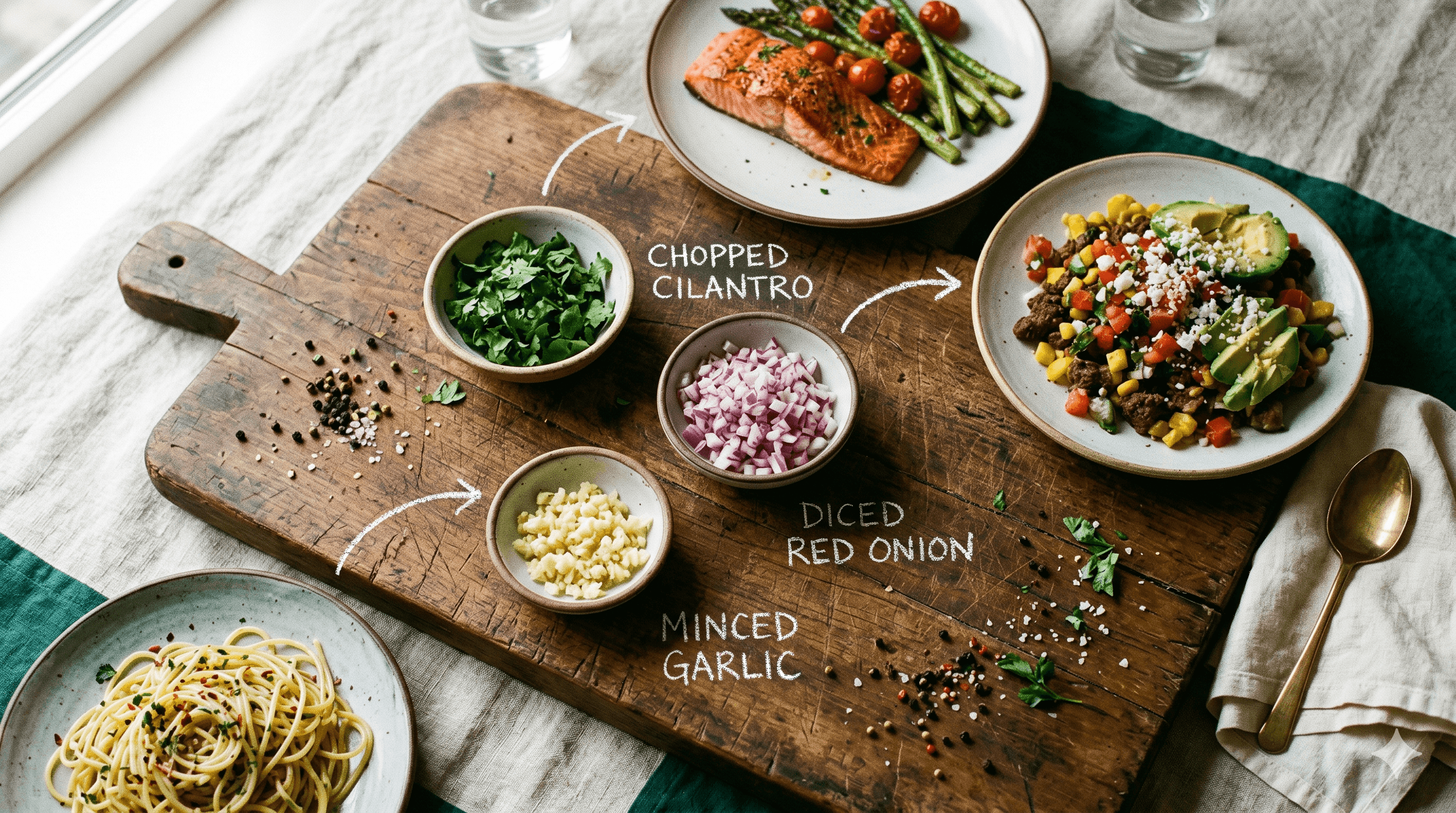
Ingredient overlap is a meal planning strategy where you choose recipes that share core groceries so you buy less and actually use what you buy. Instead of five disconnected recipes with five separate shopping lists, you plan dinners that reuse the same chicken, onions, herbs, and grains across the week. Your grocery list gets shorter and your fridge stays cleaner.
The problem this solves
Most households plan dinner one recipe at a time. Monday's stir-fry needs sesame oil and fresh ginger. Tuesday's pasta calls for a jar of sun-dried tomatoes. Wednesday's tacos require a bunch of cilantro. Each recipe demands its own set of purchases, and you only use a fraction of each before the rest expires.
According to the USDA and the Natural Resources Defense Council, the average American household wastes between $1,500 and $2,900 per year on food that gets purchased and never eaten. That is roughly 20% to 30% of a typical grocery budget going straight into the trash. Most of it starts with one-off ingredients bought for a single meal.
How it works in practice
The idea is straightforward: instead of picking five random recipes and buying everything they need, you pick recipes that share a common ingredient core.
Here is a simple example using basil pesto as an anchor ingredient:
| Night | Dinner | Shared ingredient |
|---|---|---|
| Monday | Pesto baked chicken with roasted vegetables | Basil pesto, chicken, olive oil |
| Wednesday | 15-minute pesto pasta with cherry tomatoes | Basil pesto, olive oil, parmesan |
| Friday | Toasted sandwiches with pesto, mozzarella, and roasted peppers | Basil pesto, olive oil |
One jar of pesto. Three completely different dinners. You use the whole jar instead of two tablespoons, and your grocery list has fewer total items.
Now scale that across more ingredients. The same onions, the same block of cheese, the same bag of spinach appearing in multiple meals. The savings add up fast.
Shared ingredients vs. traditional meal planning
| Traditional meal planning | Planning around shared ingredients | |
|---|---|---|
| How recipes are chosen | Independently, based on cravings or rotation | Clustered around common groceries |
| Grocery list size | Longer, with unique items per recipe | Shorter, with items reused across recipes |
| Food waste | Higher, because leftover ingredients expire unused | Lower, because most items appear in multiple meals |
| Flexibility when plans change | Low, since skipping a meal strands its ingredients | Higher, because shared items flex into other meals |
| Weekly grocery cost | Higher due to one-off purchases | Lower due to fewer unique items |
Why it works especially well for shared households
I first noticed this when my partner and I were shopping from a list tied to five totally unrelated recipes. The list was absurdly long, and neither of us could make sense of the other's additions. When your dinners share a common set of groceries, the list is short enough that it doesn't matter who stops at the store.
For couples, roommates, and small families, reusing groceries across meals also cuts down on coordination. Fewer ingredients means fewer things to track and fewer emergency runs mid-week when somebody forgot the one item that only goes with Tuesday's dinner.
Automating the hard part
Planning meals around shared ingredients makes sense on paper. Actually doing it every week is tedious. I tried it with a spreadsheet for exactly two Sundays before giving up. You have to scan recipes, cross-reference ingredient lists, and figure out where the overlaps are. It is the kind of task that computers are genuinely better at than people.
HelloMealio does this automatically. You import the recipes you already cook, pick the nights that need dinners, and the AI Meal Planner generates a weekly plan optimized for ingredient overlap. The grocery list it produces is noticeably shorter than what you'd build by hand.